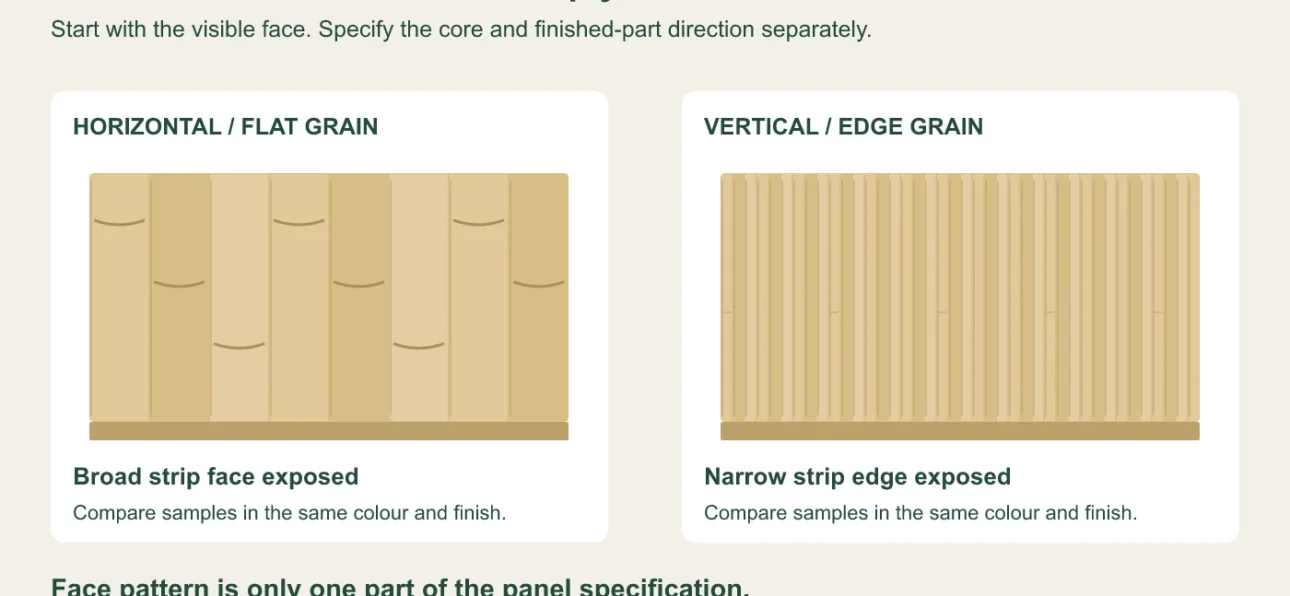
Choosing horizontal vs vertical bamboo plywood starts with the surface your customer will see. Horizontal, also called flat or plain-pressed grain, shows the broader side of the bamboo strips. Vertical, also called edge or side-pressed grain, presents a finer pattern of narrow lines.
Make three separate choices when ordering: the face pattern, the internal layer arrangement, and the direction the grain should run across each finished part. Keeping those choices separate prevents an attractive sample from becoming the wrong cabinet front or panel construction.
Illustration: compare the face patterns in the same colour and orientation.
Horizontal vs vertical bamboo plywood at a glance
These names describe the way the bamboo strips present their faces. CALI’s plywood FAQ explains the broad-strip and narrow-strip distinction. Suppliers also use the terms flat grain and edge grain, so attach an approved sample or photograph to the name.
| Face style | Appearance to compare | Useful design question |
|---|---|---|
| Horizontal / flat / plain-pressed | Broader strip faces, with bamboo node marks usually more prominent | Do you want the recognisable strip-and-node pattern to be a feature? |
| Vertical / edge / side-pressed | More closely spaced, narrow linear strips | Do you prefer a finer surface rhythm across the visible component? |
Compare candidates in the same colour and intended finish. A dark sample beside a pale sample changes two things at once, making it harder to judge the grain. Request a larger view as well as a close-up: the pattern that looks attractive on a small swatch may feel different across a door or tabletop.
The words horizontal and vertical describe a face style. Rotating a cut component changes the direction of its lines in the furniture while keeping that same face style. Record both pieces of information in the drawing.
Ask what runs underneath the face
A face photograph cannot settle the direction of the hidden layers. A fine edge-grain surface may be offered in different internal constructions, just as a broad flat-grain surface can be. Ask for a section drawing and sample edges that identify the layers.
Plyboo’s manufacturing and working guide describes both cross-core and linearly laminated products. In a cross-core example, the middle layer runs across the outer layers. In a linear construction, the strips run in the same overall direction. These are separate construction decisions from the visible face pattern.
Use clear arrows on the proposed build-up: face along the sheet length, core across the sheet width, reverse along the sheet length, for example. Include the layer thicknesses and total finished thickness in the actual specification. A shorthand such as “three-layer” or “H-type” should be accompanied by the supplier’s drawing.
For a wide cabinet door, shelf or exposed tabletop, share the component dimensions, supports and joints. Let the supplier assess the exact proposed construction for that use. The finer-looking face does not, by itself, establish a higher load rating or better moisture performance.
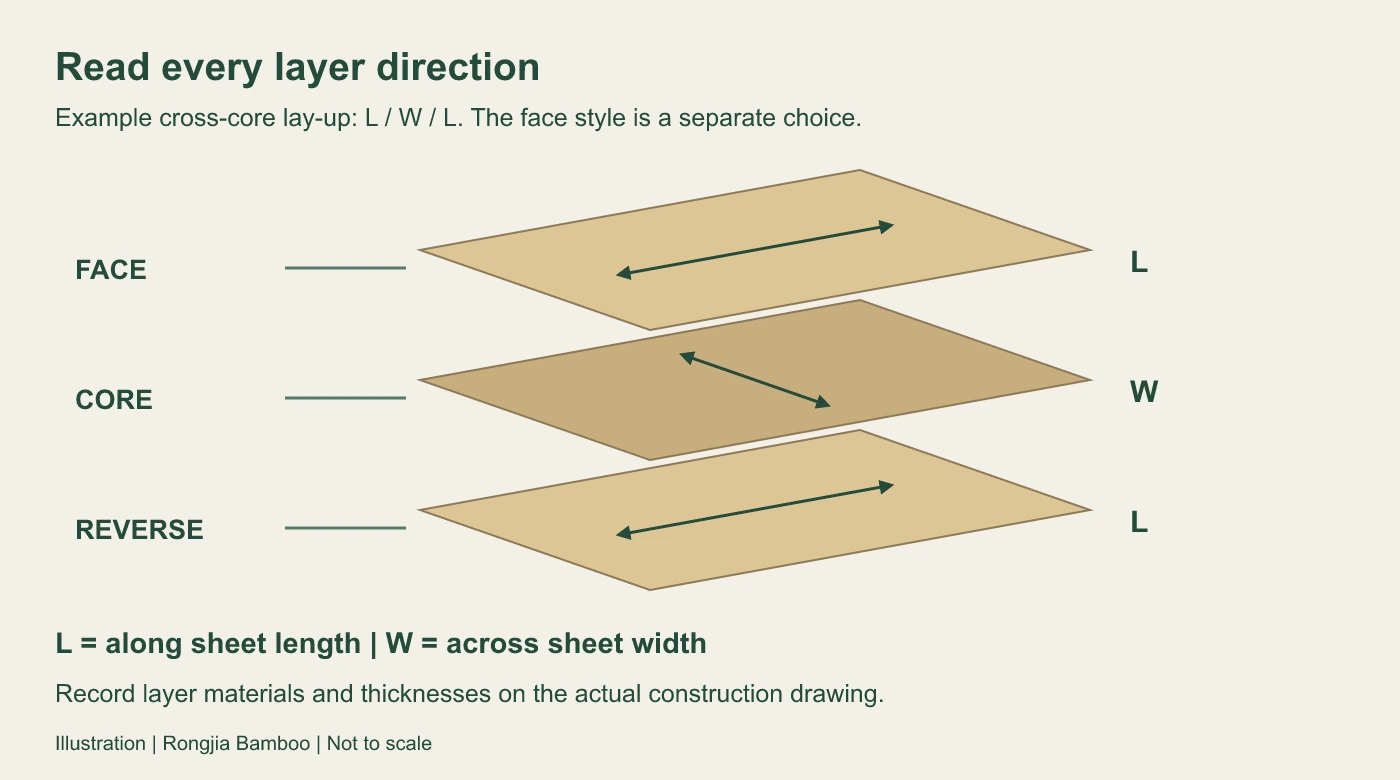
Rongjia’s bamboo panel construction comparison is the starting point for selecting the build-up. We specify carefully selected core material to the same quality standard as the faces; the core’s material quality and its grain direction belong in separate requirements. Our quotation comparison guide explains the core-quality and pricing questions in more detail.
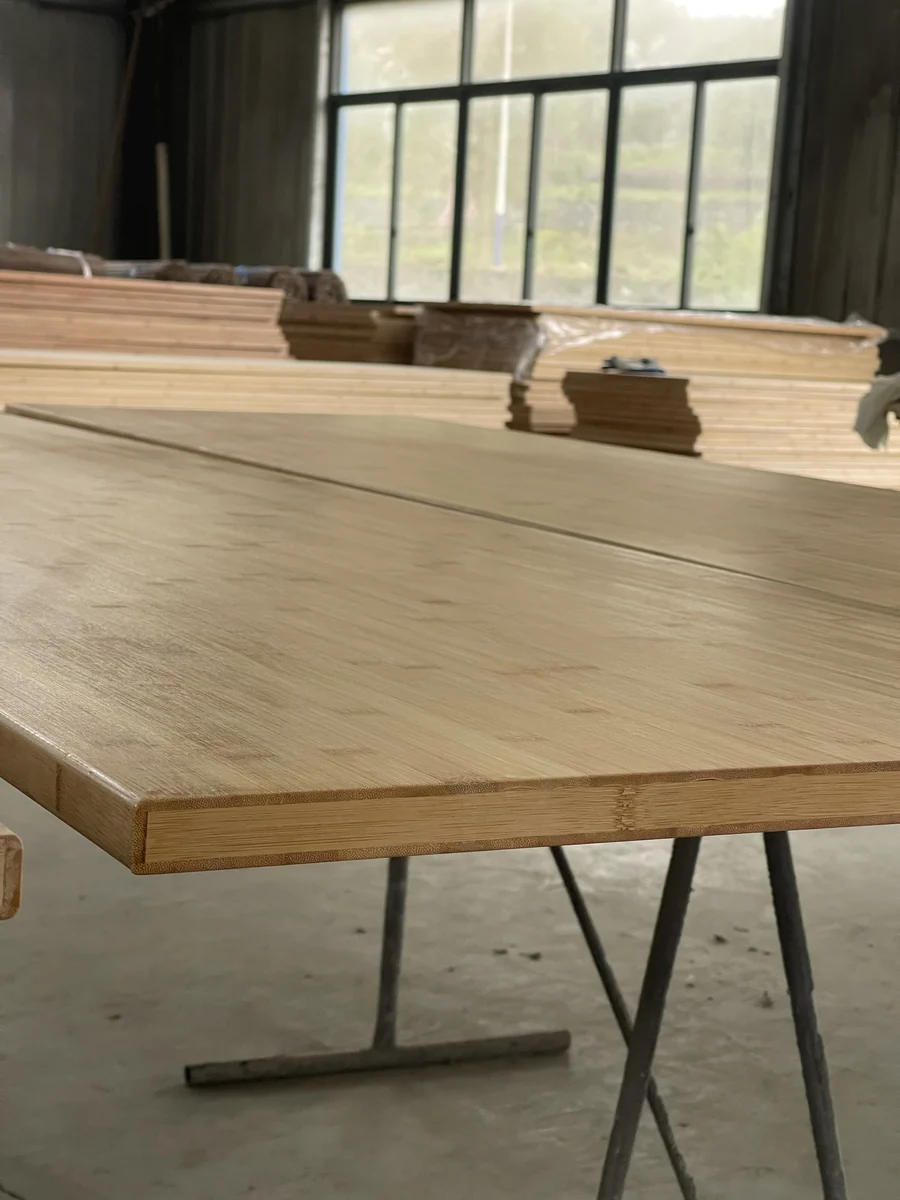
Put a grain arrow on every visible component
Consider two adjacent cabinet doors. Both can use vertical-grain bamboo plywood, yet one can be cut with the grain running up the door and the other with it running across. The face-style name remains the same; the visual result changes.
Mark the grain direction on the front elevation, meaning the drawing showing the finished furniture from the front. Add the visible face and a reference edge. Do this before the cutting layout is approved, because rotating a part to fit a sheet can change the appearance of the finished set.
For neighbouring doors or drawer fronts, also decide whether the grain should continue across the joint or simply have a coordinated appearance. A continuous pattern requires a particular cutting and sequencing plan; a matching colour alone does not define that plan. Have the fabricator confirm what is achievable before approving the order.
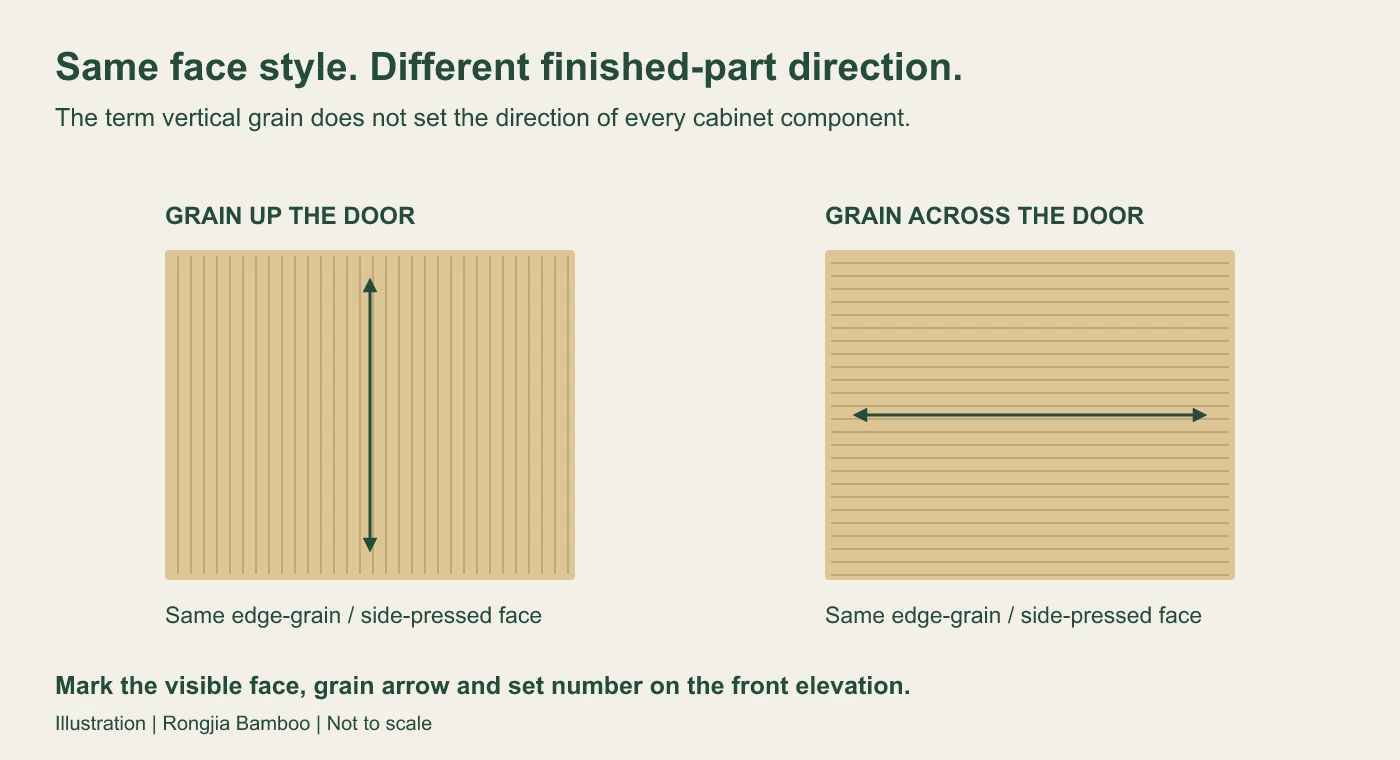
Keep accepted parts together by set number through cutting, packing and assembly. Labels such as a door position and drawing revision are more useful than a generic “vertical bamboo” label when several similar pieces arrive together.
Approve the visible result and the order record together
Lay the candidate samples in their intended directions under the same lighting. Compare strip pattern, node appearance, colour variation and the edges that will remain exposed. Check the planned coating on a sample before accepting the final appearance.
For an exposed edge, inspect two adjacent cut edges as well as the face. Different views help connect the physical sample to the layer drawing. If hidden core material is part of acceptance, agree the inspection and any cut samples beforehand.

Use a short order record to keep the choices together:
| Field | What to record |
|---|---|
| Face style and appearance | Supplier’s name, approved sample ID, colour and finish |
| Internal construction | Section drawing, layer materials, directions and thicknesses |
| Finished component | Part ID, dimensions, visible face, grain arrow and exposed edges |
| Matching and inspection | Set numbers, approved photographs and agreed acceptance checks |
Send that record with your panel inquiry to Rongjia. It gives the factory, fabricator and inspector the same reference for what the customer should see and what the panel should contain.