
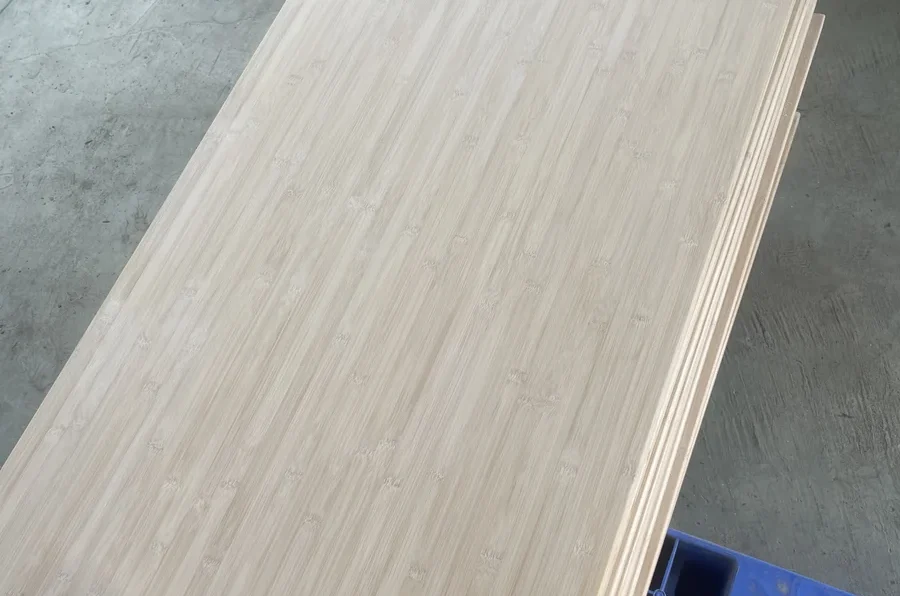
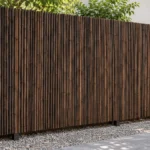
Rongjia bamboo panels with lengthwise grain across the face.
A bamboo plywood price displayed online usually refers to one sheet in a particular size and thickness. That number is useful only when you know exactly what it buys. Rongjia calculates panel quotations by cubic metre, then converts the quotation into a price per sheet or square metre when customers need those units.
To compare offers, follow the same sequence: establish the dimensions and construction, understand the production route, check the material inside the panel, and agree how the order will be inspected. Here is what each step changes in your purchasing decision.
1. Compare bamboo plywood price with thickness included
Many listings show a fixed-specification sheet price. A thinner sheet can display a smaller price without offering a lower rate for an equivalent specification. Price per square metre describes face area; it does not identify thickness. Keep thickness beside every area price.
Rongjia’s cubic-metre quotation includes length, width and thickness in the volume calculation. With all dimensions expressed in metres:
Sheet volume in m³ = length × width × thickness.
Sheet price = quoted price per m³ × sheet volume.
Price per m² = sheet price ÷ sheet area.
For a 2440 × 1220 mm sheet, the area is 2.9768 m². The volumes for two finished thicknesses are:
| Finished thickness | Sheet volume | Sheet price using its quoted rate |
|---|---|---|
| 20 mm | 0.059536 m³ | 0.059536 × the quoted 20 mm rate per m³ |
| 17 mm | 0.0506056 m³ | 0.0506056 × the quoted 17 mm rate per m³ |
Using a cubic-metre basis makes the dimensions explicit. It does not mean every thickness or construction has the same cubic-metre rate. Ask for the applicable rate and the finished sheet price together. The sheet sizes and thickness guide helps you specify the dimensions.

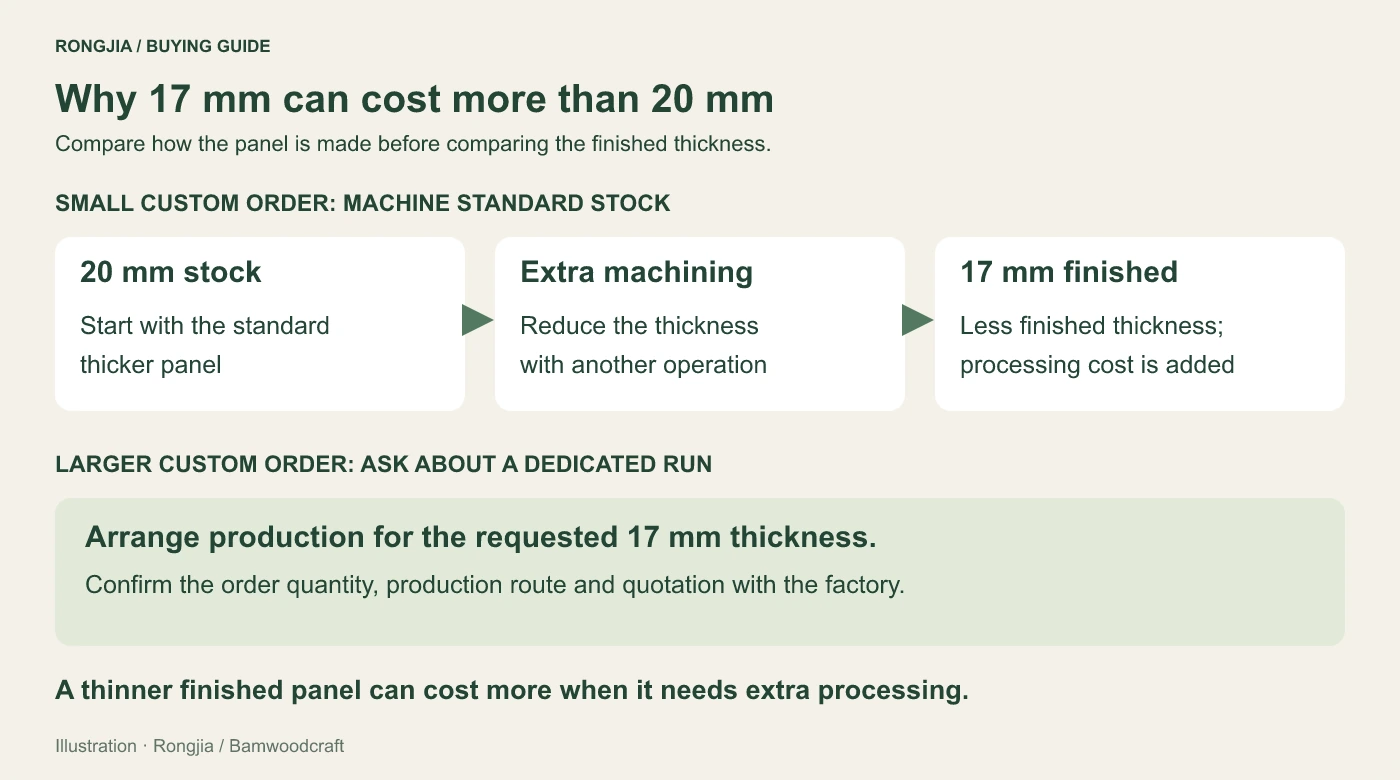
2. Why can a custom 17 mm panel cost more than 20 mm?
Less finished material does not always mean a lower finished price. Rongjia explains that, for a small custom order, a requested 17 mm panel may be machined down from standard 20 mm stock. The factory still starts with the thicker board and adds a thickness-reduction operation.
That extra processing can make the finished 17 mm panel more expensive than the standard 20 mm option. Multiplying the 20 mm price by 17/20 would miss the production route and give a misleading budget.
For a sufficiently large custom order, Rongjia may arrange a dedicated 17 mm production run instead. Producing for that thickness can bring the cost down compared with machining standard stock. Ask the factory to quote the quantity required for that production route.
Ask two questions: Will this thickness be produced directly or machined from thicker stock? What quantity makes a dedicated run possible? If your design allows 20 mm, request both options before finalising it.
3. Check what is inside the panel
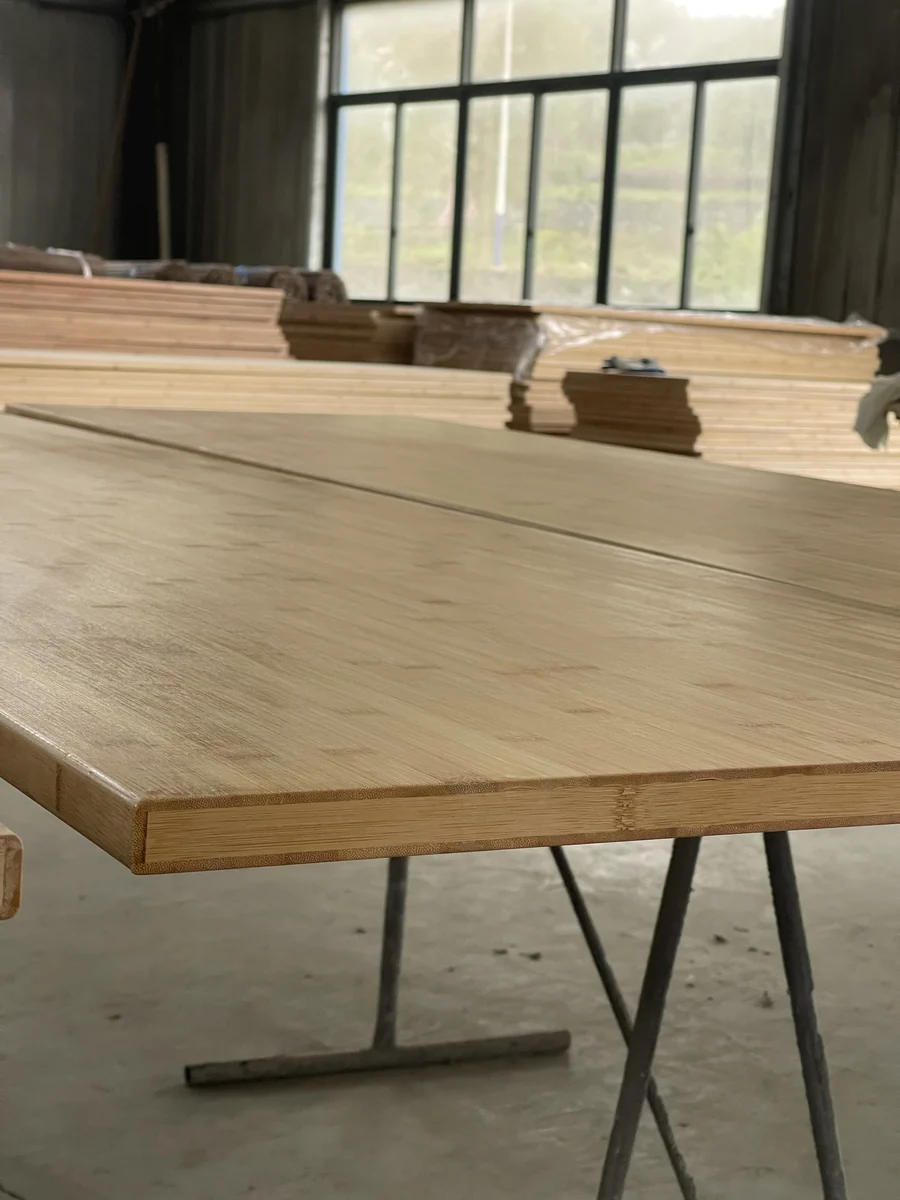
Matching dimensions and a three-layer description do not establish equivalent material quality. For H-structure or cross-ply panels, ask for a section drawing showing the layer arrangement, then specify the material quality required in each layer. The bamboo plywood product page is the starting point for selecting a construction.
A neat outer face does not tell you how carefully the hidden core was selected. Lower-grade pieces or defective offcuts inside a panel are a risk to check; a low price alone is not evidence that a particular supplier uses them.
At Rongjia, we select the same high-quality, defect-free material for the core and the faces. For H-structure and cross-ply panels, confirm the layer arrangement separately from the material grade. Specify both requirements in writing and approve a representative cross-section sample.
Compare core quality on the quotation alongside construction and dimensions. Otherwise, two offers may look equivalent while pricing different material standards. A photograph of the face alone cannot resolve that difference.

4. Make independent inspection part of the order
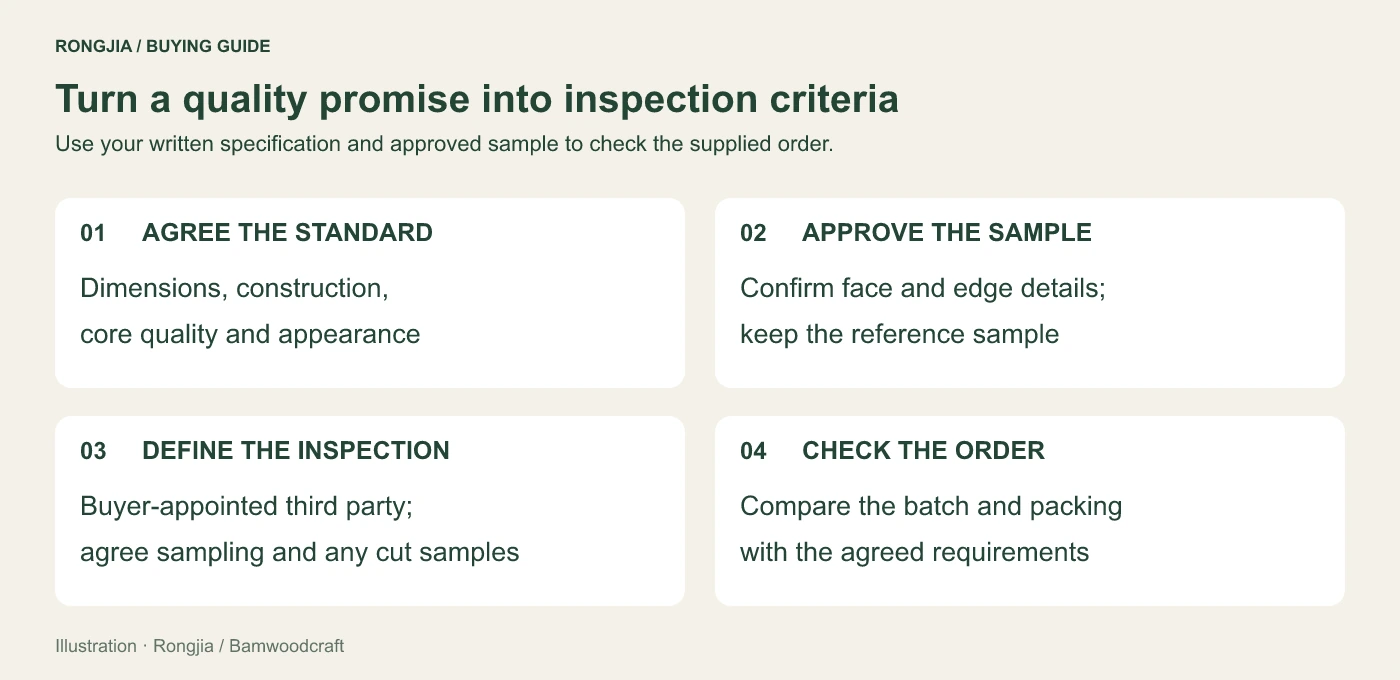
We recommend a buyer-appointed third-party inspection before shipment. Give the inspector the purchase specification and approved sample, rather than asking only whether the panels look acceptable. SGS describes pre-shipment inspection as checking goods against technical specifications and contractual requirements.
Agree the following inspection scope with the supplier and inspector before production:
| Check | Written requirement to supply |
|---|---|
| Dimensions | Finished length, width, thickness and agreed tolerances |
| Construction and core | Layer arrangement, core-material criteria and approved section sample |
| Appearance | Agreed limits for defects, colour variation and visible surfaces |
| Order and packing | Quantity, identification, packing and required documents |
If checking the hidden core requires cutting samples, agree sample selection and permission for destructive examination in advance. A surface-only inspection cannot verify the whole interior. Laboratory tests, when required, must also be separately specified; a visual inspection report does not replace them.
5. Send information that makes the quotation usable
Copy this request into your inquiry:
Please quote [construction] bamboo panels, finished size [length × width × thickness] with [tolerances], quantity [sheets], for [application]. Include [surface and core requirements], [finish] and drawing [revision]. For custom thickness, state whether production uses thicker stock or a dedicated run, and quote both quantities if applicable. Provide the rate per m³, equivalent sheet price, packing, delivery basis, lead time and quote validity. Confirm acceptance of buyer-appointed inspection against our specification.
When you request a Rongjia quotation, include any acceptable standard-thickness alternative. Compare the bamboo plywood price against that complete specification, then verify the supplied order. The smallest advertised number cannot answer those questions on its own.


2 Comments
[…] the core’s material quality and its grain direction belong in separate requirements. Our quotation comparison guide explains the core-quality and pricing questions in more […]
[…] and thickness, then separate the agreed machining, finishing, packing and delivery scope. Our bamboo plywood price guide explains the unit […]