Ordering bamboo plywood 3/4 inch thick does not settle the thickness your cabinet shop should use. Three quarters of an inch converts to 19.05 mm, but a catalogue can pair the same inch label with 19 mm. An offered 20 mm panel is another specification. Agree the delivered thickness and tolerance before releasing cutting drawings.
For furniture buyers, the useful question is: which dimension must stay fixed when the material changes? A small thickness difference affects both sides of a cabinet, the width of a fitted component, and the fit of a panel in a groove.
AI-generated illustration: bamboo panel thickness and cabinet assembly.
Specify bamboo plywood 3/4 inch by finished thickness
NIST defines one inch as exactly 25.4 mm, so 0.75 × 25.4 = 19.05 mm. This is a unit conversion, not a manufacturing tolerance.
For example, Plyboo’s flat-grain product table lists its 3/4-inch format alongside 19 mm. That tells you how the catalogue describes the product; it does not establish the measured range of every delivered sheet.
| Thickness description | What it tells you | What still needs agreement |
|---|---|---|
| 3/4 inch | Exact conversion is 19.05 mm | Delivered target and permitted variation |
| 19 mm | A stated metric thickness | Whether this is nominal or required finished size |
| 20 mm | A different stated thickness | Whether the design accepts it or requires a new production proposal |
Write the target thickness, permitted variation, and surface condition into the order. Specify whether acceptance is before or after the agreed sanding and finish. “3/4 inch, or similar” leaves the fabricator to resolve a decision that belongs in the purchase specification.

A thickness change affects two cabinet sides
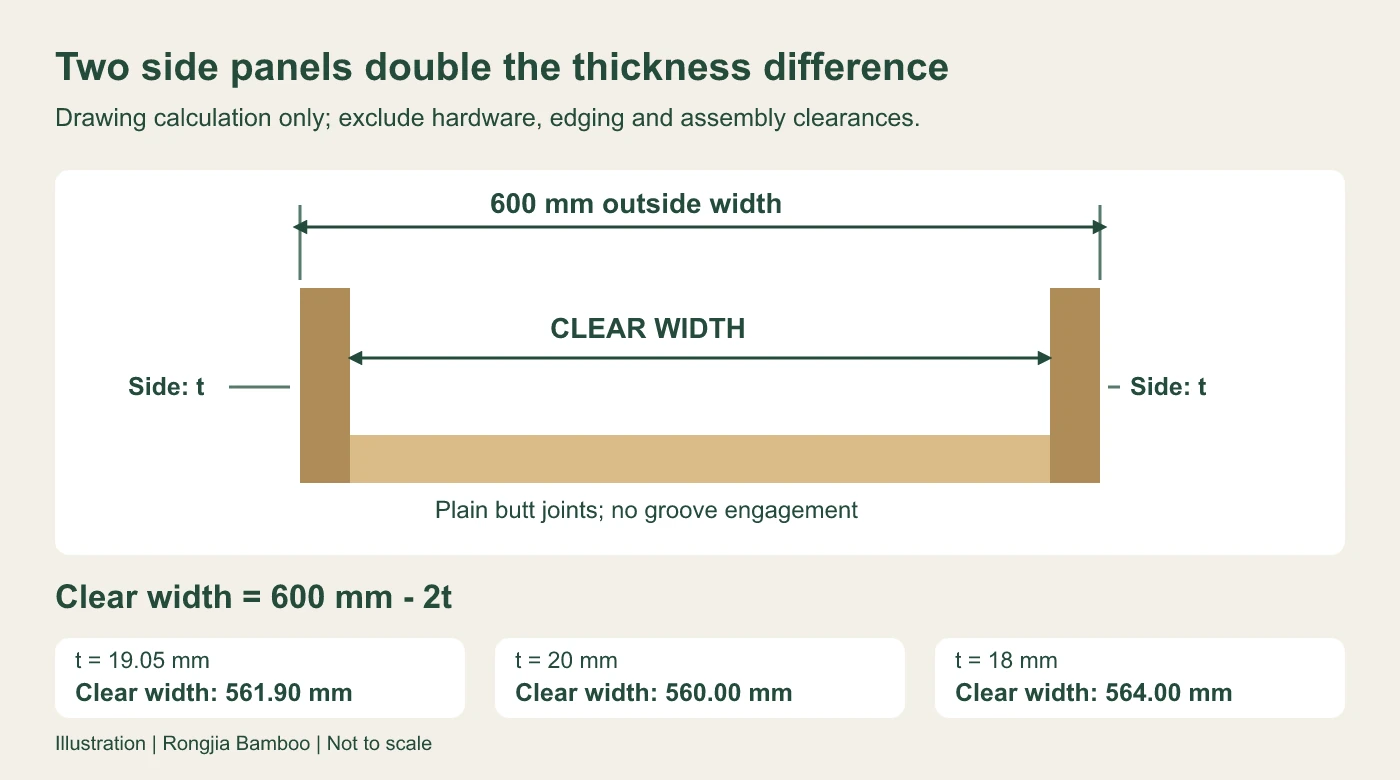
Consider a simple cabinet with an outside width of 600 mm, two equal side panels, and a horizontal component fitted between them. With plain butt joints and no groove or rebate engagement, the clear width is:
Clear width = outside width − twice the side-panel thickness.
| Side-panel thickness | Calculation | Clear width |
|---|---|---|
| 19.05 mm | 600 − 2 × 19.05 | 561.90 mm |
| 20 mm | 600 − 2 × 20 | 560.00 mm |
| 18 mm | 600 − 2 × 18 | 564.00 mm |
Changing from 19.05 to 20 mm reduces that opening by 1.90 mm. The difference is doubled because there are two sides. These are drawing calculations, before hardware allowances, assembly clearances or edging; they are not finished drawer dimensions.
Choose the controlling dimension first. If the outside width must stay at 600 mm, revise the parts between the sides. If an internal opening must remain unchanged, revise the outside dimension instead. Do not change the material thickness while leaving both dimensions locked to the old drawing.
The same logic applies to a groove, meaning a slot receiving a panel edge. With the slot width unchanged, a thicker panel leaves less clearance and a thinner panel leaves more. Let the fabricator set the required fit using the actual panel and assembly; there is no universal groove allowance for every joint.
Match the construction as well as the thickness
Two panels of the same thickness can still have different layer arrangements. Record the face grain, number of layers and direction of the core separately. A surface photograph helps choose the appearance; a cross-section sample helps define the construction.
Use Rongjia’s bamboo panel construction comparison to identify the proposed build. For overall sheet formats, see the bamboo plywood sheet-size guide. Neither a matching thickness nor a familiar face grain establishes a shelf load rating or makes different constructions interchangeable.
Rongjia specifies carefully selected core material to the same quality standard as its faces. Put the agreed core requirements in writing, with a reference sample and an inspection method for hidden layers. Core quality and core grain direction answer different questions.
If available stock is thicker than the required finished panel, ask the supplier to propose the production route. Confirm the resulting surface and layer arrangement before approving any reduction. Do not assume an arbitrary amount can be removed from either face, or calculate a new price simply by multiplying the old quote by a thickness ratio. Rongjia quotes by cubic metre for the specified product; changed specifications need their own quotation.

Give the supplier and inspector the same drawing
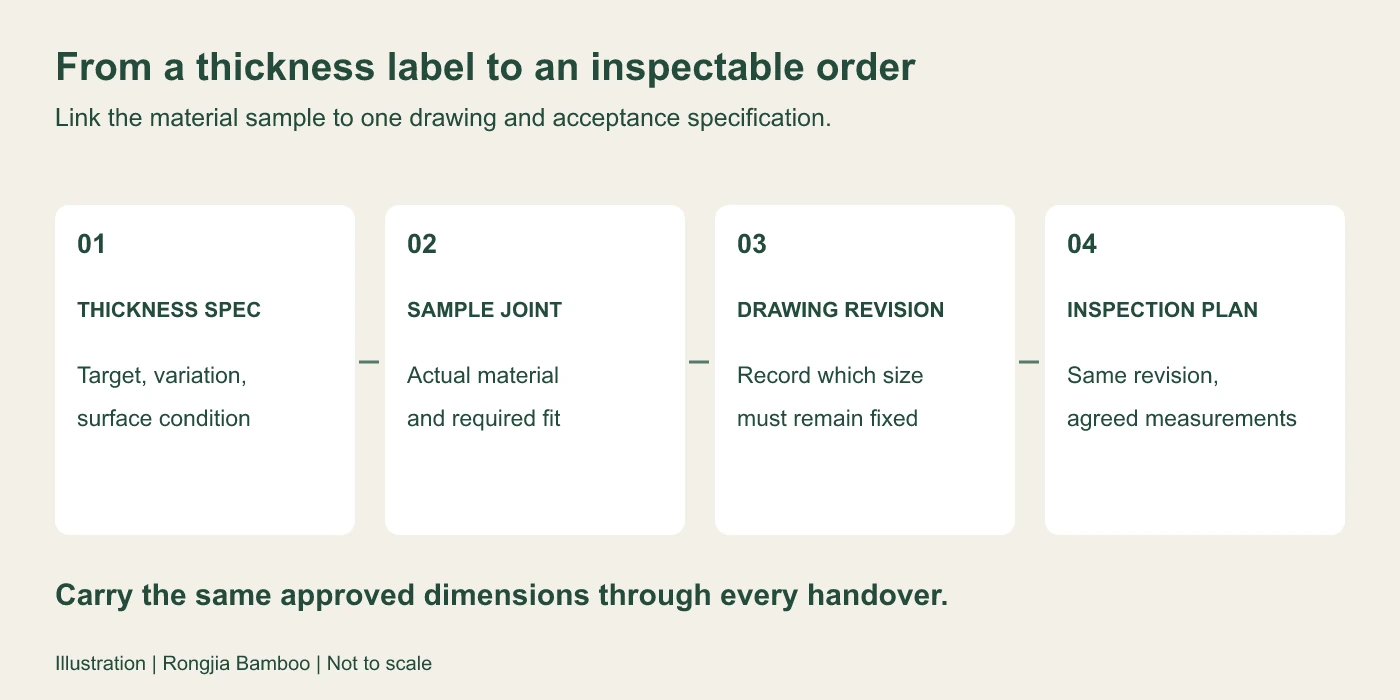
Approve a sample in the condition your fabricator will receive. Record thickness measurements at agreed points, the measuring method and the material condition. Keep the sample identity with the drawing revision so a later substitution is visible.
Before the full run, have the fabricator check a representative joint or hardware assembly with that sample. This resolves fit questions that a catalogue label cannot answer. Agree any preparation for the intended workshop and installation conditions with the panel supplier.
For buyer-appointed third-party inspection, provide the same revision, target thickness, permitted variation, sampling plan and construction requirements. If core inspection requires cutting samples, authorize that beforehand. The inspection report should identify what was checked against the order.
Send this with your panel inquiry to Rongjia:
We need bamboo plywood for [component]. Required delivered thickness: [value and unit], permitted variation: [range], surface condition: [unfinished or specified finish]. Drawing revision: [reference]. Keep [outside width or internal opening] fixed. Proposed construction and face grain: [details]. Quantity: [sheets or volume]. Please confirm the production route, sample arrangement and quotation. Our appointed inspector will use the agreed drawing and inspection plan.