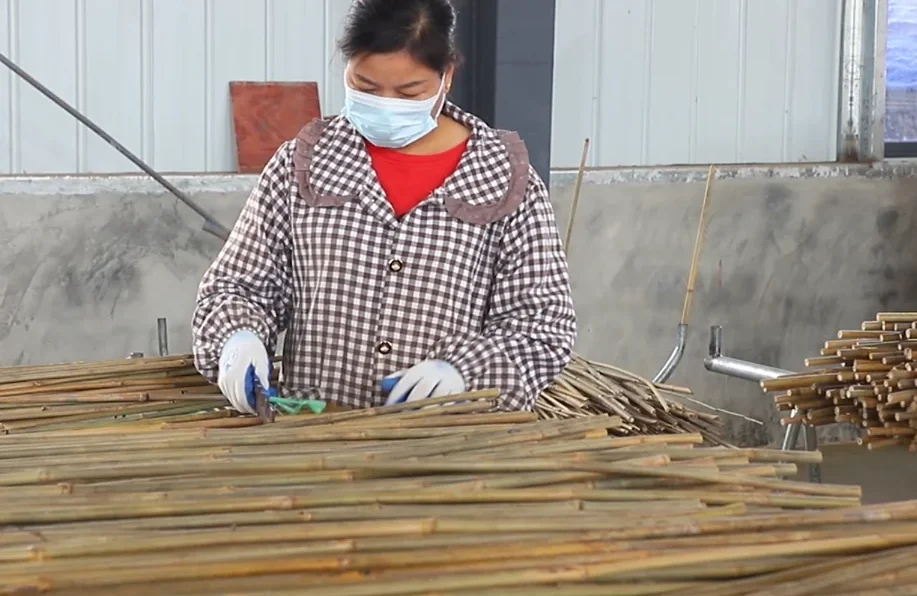
Factory photograph: bamboo sorting on Rongjia’s fencing production line. Use an approved finished sample to agree the appearance and spacing required for the order.
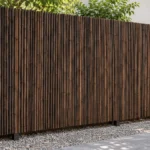
A bamboo privacy fence should solve a specific problem: hide an unattractive fence, soften views from a path, or stop people looking directly at a seating area. These jobs need different buying decisions. Covering a solid wall is mainly an appearance choice; screening an open chain-link fence depends on the openings in the bamboo itself.
Start with the construction, then compare gaps and a sample in the intended position. Here is a practical way to shortlist products and ask for quotations you can actually compare.
1. Which bamboo privacy fence construction should you shortlist?
Our fencing catalogue includes these three different constructions. The dimensions below describe the bamboo pieces, not the openings between them.
| Catalogue option | Published material size | When to shortlist it | What to compare on the sample |
|---|---|---|---|
| Natural Split Moso Bamboo Fence | Slat width 20–60 mm | You prefer a strip-based face rather than a round-pole look | Actual strip width, edge shape and gaps across several neighbouring strips |
| Natural Round Wenli Bamboo Fence | Pole diameter 14–24 mm | You want visible rounded poles and nodes | Diameter variation, straightness and the openings where poles sit together |
| Woven Bamboo Branch Garden Fence | Branch diameter 8–14 mm | You want an irregular, textured branch pattern | Openings throughout the woven area, rather than one dense-looking close-up |
Choose the appearance you want, then compare the actual assembly. “Round,” “split” and “woven” are construction descriptions, not privacy ratings. A wider piece does not settle the choice if its neighbouring gaps are also wider. Catalogue sizes are reference ranges; confirm the selected specification and availability.
2. Two measurements buyers can easily confuse
For a bamboo privacy fence, ask for the clear gap between adjacent bamboo pieces. Do not substitute the spacing of the wires that bind the roll together.
Our catalogue lists typical wire spacing of 10 or 20 cm. That describes the binding-wire layout; it does not mean there is a 10 or 20 cm opening between bamboo pieces. Ask for a close-up with a ruler across several pieces, plus a full-width photograph with light behind it.

Worked example: imagine equal, straight, flat strips 20 mm wide with a uniform 3 mm gap. Looking directly at the face, the repeating pattern is 23 mm wide, of which 3 mm is open: 3 ÷ (20 + 3) ≈ 13%.
That is a geometric opening ratio for this imaginary pattern, not “87% privacy.” Natural edges, irregular spacing, viewing angle and lighting change what someone can see. Use the example to understand the measurement, then judge real samples; do not put the calculated figure on a product label.
3. Match the bamboo privacy fence to the actual problem
| Your situation | Useful first decision | Common mistake |
|---|---|---|
| An ugly solid fence already blocks the view | Choose the bamboo appearance, then confirm attachment to the existing structure | Paying for a denser-looking screen when the solid backing already provides the visual barrier |
| People can see through an open boundary into a patio | Compare candidate samples with an open background from the path and the seat | Approving a photograph taken against an opaque wall |
| A higher window overlooks the garden | Check the line of sight before selecting a roll height | Expecting tighter gaps to stop a view that passes above the screen |
For the last situation, hold a temporary marker at the proposed top edge and check the view from the relevant positions where access is permitted. This reveals whether the problem is height or gaps before you buy material.
A roll also needs an appropriate supporting fence or frame. Have the installer check its condition and the attachment plan. The same bamboo facing on different supports is not the same complete installation.
4. Make the sample answer three buying questions
Instead of asking “Is it private?”, give the supplier a repeatable comparison task:
- What can I see through it? View the sample with open space behind it. Put a recognisable object behind the screen, then look from the distance and angle relevant to your project. Compare candidates under the same conditions.
- Where are the largest openings? Examine several adjacent pieces, wire connections and edges. Record the largest gaps you find rather than measuring only the neatest section.
- Will the delivered material match? Keep the sample reference and dated photographs. Agree acceptable variation in colour, piece dimensions, gaps and connections before confirming the order.
If privacy after dark matters, repeat the first check using the planned evening lighting. A daytime photograph cannot answer that question.
For outdoor use, ask for the coating and care instructions for the selected product, including how the bottom edge should avoid prolonged ground moisture. Bamboo Australia’s product guidance illustrates why outdoor maintenance belongs in the buying discussion; its coating recommendations are specific to its products. Obtain Rongjia’s instructions for your selection.
5. A bamboo privacy fence inquiry you can copy
Replace the brackets before sending:
Product: [name/construction]. Destination: [port/country].
Size and quantity: [height] × [roll length]; [rolls or square metres].
Installation: covering [solid fence/open fence/new frame].
Privacy goal: reduce views from [observer position] into [area].
Please confirm: bamboo piece dimensions; gap specification and measurement method; wire material/layout; finish and outdoor care; roll net weight; packing dimensions; loading quantity.
Sample views: comparable front, angled and backlit photographs.
Price basis: state the delivery terms and any excluded freight or handling charges.
Compare quotations on the same dimensions, packing and delivery basis. A lower price per roll can be misleading when roll areas differ. Use our roll buying guide for size and quantity planning.
Rongjia’s current fencing wholesale minimum is one 40HQ container. The loading quantity depends on the chosen products and packing. Send your specification for a wholesale quotation and request a loading plan for that selection.