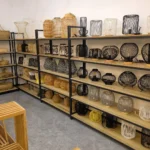
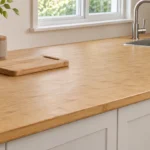
Factory photograph: a clamped bamboo component during machining on Rongjia’s cutting-board line. This is a process reference, not a thin-panel test.
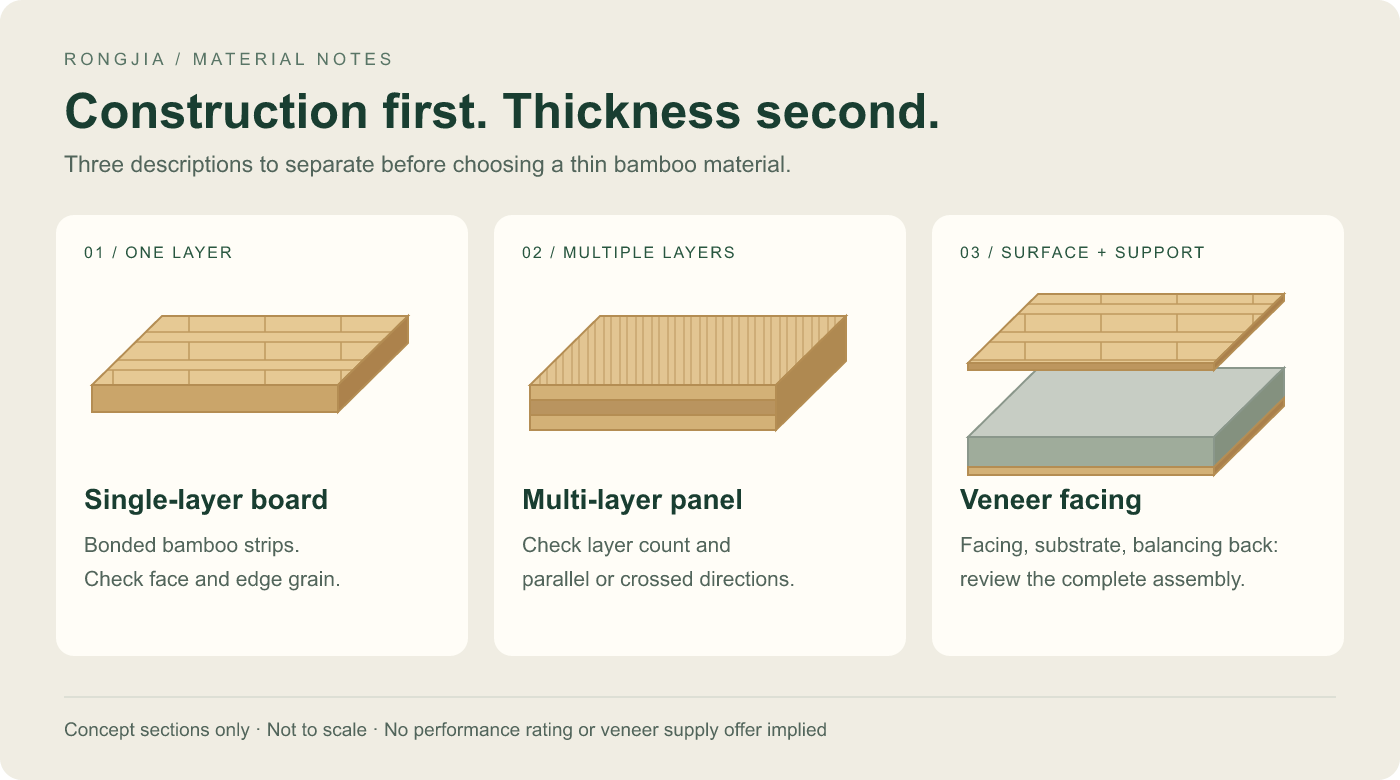
Thin bamboo plywood is a useful search term, but it does not identify one standard product. A thin single-layer bamboo board, a multi-layer bamboo panel and a bamboo veneer facing can look similar in a photograph while requiring different support and fabrication methods.
Start with what the finished component must do. Is it a decorative face bonded to another board, an insert held in a frame, or a small part with visible edges? That decision is more useful than choosing the lowest thickness first.
Thin bamboo plywood, single-layer board or veneer?
Ask the supplier to describe the cut edge as well as the face. “Bamboo panel” is a broad term; “plywood” in a search result does not guarantee cross-laminated layers.
“Single-layer” describes the board’s layer count, not an absence of glue: bamboo strips are bonded together within that layer. A multi-layer panel adds layers through the thickness, with directions that must be specified.
| Material description | What to establish | Why it matters |
|---|---|---|
| Single-layer bamboo board | One layer of bonded bamboo strips; flat-pressed or edge-pressed | Grain and edge appearance differ from a multi-layer panel |
| Multi-layer bamboo panel | Number of layers and whether their directions are parallel or crossed | Equal thickness does not mean equal construction |
| Bamboo veneer facing | Facing thickness, backing and intended substrate | The complete bonded assembly needs its own specification |
A veneer is a surface material for an assembly, rather than a substitute for a freestanding board. If your drawing needs a veneer, say so explicitly. Do not assume a panel supplier offers that format simply because it sells bamboo sheets.
Which thin bamboo panel options are in our catalogue?
The thinner choices in Rongjia’s current panel construction comparison are listed below. These are reference specifications, with availability, tolerances and finish confirmed during quotation.
| Construction | Thinner catalogue options | Reference sheet size |
|---|---|---|
| Single-Ply Vertical: one edge-pressed layer | 3 / 5 mm | 2000 × 600 mm |
| Single-Ply Horizontal: one flat-pressed layer | 4 / 5 / 6 mm | 2000 × 600 mm |
| Two-Ply Horizontal: two parallel flat-pressed layers | 5 / 6 mm | 2000 × 600 mm |
These rows select the thinner options, rather than reproduce the full thickness range. In particular, the two-ply construction has parallel layers; it should not be specified as cross-ply.
The 3 mm option belongs to the edge-pressed single-layer construction. It is not a blanket offer of 3 mm material in every grain or sheet format. For larger sheet dimensions and unit conversions, use our separate sheet size and thickness guide.
Choose thin bamboo plywood around support and edges
For a decorative facing, describe the substrate, bonding method, visible edges and reverse face. Thin single-layer panels may also be used as facings. Ask your fabricator to specify a balanced build-up, including a suitable balancing back where required, to limit bowing. A single facing bonded to one side should not be assumed to make a stable assembly.
For a proposed framed insert, send the groove depth, clearance and finished opening dimensions. Have the fabricator confirm whether that construction needs a carrier or additional support. Check actual samples against the joint rather than relying on nominal thickness alone.
For a small component, identify holes, slots, narrow tabs and fasteners on the drawing. If it carries a load or spans between supports, have the complete design assessed. This guide provides no span rating or screw-holding value for a thin panel.
Our furniture panel page is a useful starting point for a material discussion. Suitability still depends on the component and its construction.
Read the bamboo grain before drawing the cut list
Flat-pressed faces show a wider strip pattern, while edge-pressed faces show finer linear grain. Decide which appearance suits the visible surface, then mark that direction on every component drawing.
Check the face and cut edge together. A narrow decorative part may expose more edge than face, so a surface photograph alone can be misleading. Request a sample that includes both surfaces and the proposed finish.
Next, lay out the actual parts within the confirmed usable sheet size. Allow for trimming and the cutting method. Turning a part to improve yield may change the visible grain direction, so agree that trade-off before ordering.
Test thin bamboo plywood before production
Order a representative material sample and make the most demanding feature first. Include the smallest hole, narrowest section and most visible cut edge, rather than testing only an easy rectangular piece.
Use the intended cutting and finishing process. Inspect edge breakout, surface marks and the fit of mating parts. For bonded facings, test the selected substrate, adhesive and reverse-face treatment together, following the adhesive supplier’s instructions.
Thinness alone does not establish flexibility or laser-cutting suitability. Before considering laser processing, confirm the exact material and adhesive with the supplier and the equipment manufacturer. Keep the approved sample construction unchanged for production.
Keep an agreed reference sample and record the construction, measured thickness, finish and drawing revision. That record gives both sides something concrete to compare when reviewing production pieces.
Plan handling, storage and the wholesale inquiry
Ask how the sheets will be supported, protected at the edges and packed for your route. Store them flat with suitable support and protect them from moisture. Bamboo panels can change dimension as humidity changes; ask the supplier to specify conditioning and moisture checks for the intended installation environment before machining or bonding. The USDA Forest Products Laboratory provides general background on moisture control during storage and fabrication, rather than product-specific bamboo limits.
Our current wholesale minimum is 50 panels. Send the intended use, construction, length, width, thickness, quantity and destination. Add the grain direction, finish, tolerances and any adhesive, emissions or other document requirements. Confirm what can be supplied before approving the order.
Attach a drawing and describe your planned sample test when you request a panel quotation. A clear component specification helps the factory review the material and packing together.
Thin bamboo plywood: common buying questions
Is a 3 mm bamboo board the same as 1/8 inch?
No. Exactly 1/8 inch is 3.175 mm. If a quotation uses it as a nominal label for 3 mm material, confirm the actual thickness and tolerance. Specify one unit system and check the sample against your joint.
Can I bend a thin bamboo panel around a curve?
Do not assume a bend radius from thickness alone. Send the curve, grain direction and assembly details for a material review and sample trial. No bending radius is promised here.
Is the thinnest board best for a decorative facing?
Choose around the complete assembly. Surface appearance, substrate, bonding process, reverse face and edge detail can matter as much as the nominal thickness. Confirm the build-up with your fabricator before placing a volume order.