




- What Is FSC Certification?
FSC Certification for Bamboo Products is increasingly becoming a critical requirement for international buyers, brands, and government projects seeking verified sustainable sourcing.
FSC stands for Forest Stewardship Council, an independent, non‑profit organization that sets internationally recognized standards for responsible forest management. FSC certification ensures that forest‑based materials—including bamboo—are sourced from forests or plantations managed in an environmentally responsible, socially beneficial, and economically viable way.
For bamboo products
- FSC certification verifies that the bamboo raw material comes from responsibly managed bamboo forests
- Supply chain follows strict traceability rules.
In today’s global market, FSC certification has become a key purchasing requirement for many international buyers, especially in Europe, North America, and Australia.
- Is Bamboo Eligible for FSC Certification?
Yes. Although bamboo is technically a grass rather than a tree, it is fully covered under the FSC system.
FSC recognizes bamboo as a non‑timber forest product (NTFP), and bamboo plantations or managed bamboo forests can be FSC certified if they meet the standard requirements.
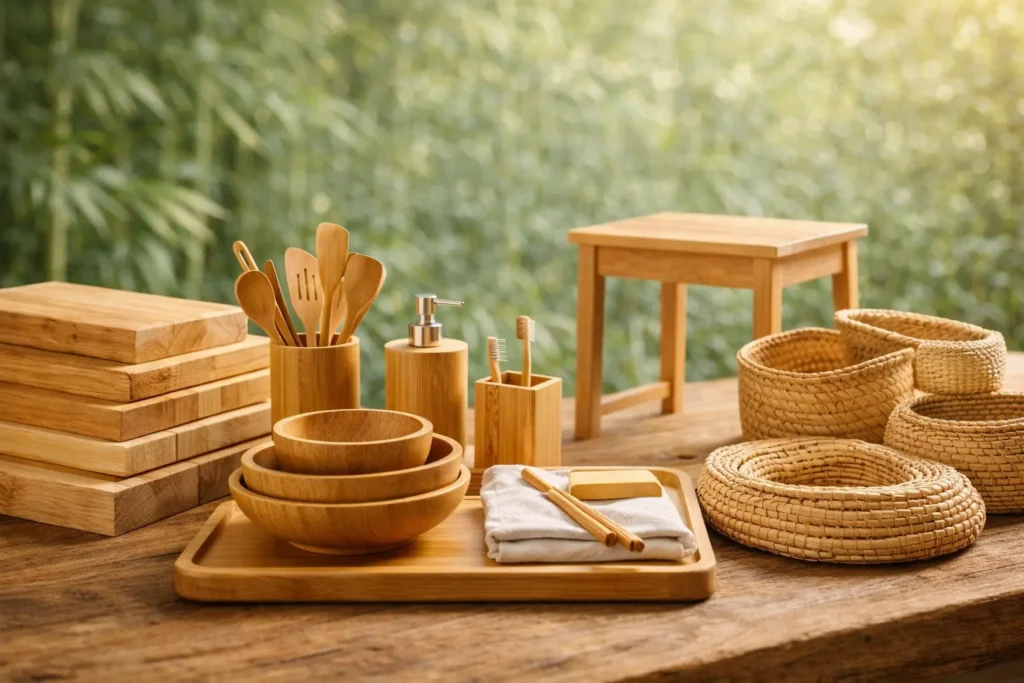
Bamboo Kitchenware
Bamboo Furniture
Bamboo Bathroom Accessories
Bamboo Paanels
bamboo Pendant Light
Bamboo Handicrafts
- Types of FSC Certification for Bamboo Products
Understanding FSC certification types is critical for buyers and brands.
FSC Forest Management (FSC‑FM)
This certification applies to the bamboo forest or plantation itself.
It verifies that: – Bamboo is harvested sustainably – Biodiversity is protected – Workers’ rights are respected – Local communities are considered
Only bamboo harvested from FSC‑FM certified sources can enter an FSC supply chain.
FSC Chain of Custody (FSC‑CoC)
FSC‑CoC certification applies to manufacturers, processors, and traders.
For bamboo product factories, FSC‑CoC certification proves that: – FSC bamboo materials are properly identified – Certified and non‑certified materials are not mixed – Full traceability is maintained from raw material to finished product
Without proper Chain of Custody control, FSC Certification for Bamboo Products cannot be legally claimed, even if the bamboo raw material itself is FSC-certified.
- FSC 100%, FSC Mix, and FSC Controlled Wood
When sourcing FSC bamboo products, buyers will commonly see these labels:
| Type | Request | Applicable scenarios |
|---|---|---|
| FSC 100% | All bamboo material comes from FSC-certified sources, no mixing with non-certified bamboo. | Premium brands and government projects. |
| FSC Mix | A mix of FSC-certified bamboo and controlled or recycled materials. Strict percentage and documentation rules apply. | Cost-sensitive projects. |
| FSC Controlled Wood | Material is risk-assessed to avoid illegal or unacceptable sources. Not the same as FSC certified | Controlled Wood cannot be marketed as FSC-certified products. |
- Why FSC Certification Matters for Bamboo Buyers
For international buyers, FSC certification is more than a label—it is a risk management tool.
- Regulatory Compliance
FSC helps meet EU Timber Regulation (EUTR), UKTR, and similar regulations.
- Brand Reputation Protection
Demonstrates commitment to sustainability and ethical sourcing.
- Supply Chain Transparency
Ensures traceability from bamboo forest to finished product.
- Retail & Marketplace Requirements
Many retailers and platforms require FSC Certification for Bamboo Products
- Common Misunderstandings About FSC Certification for Bamboo Products
Understanding FSC certification types is critical for buyers and brands.
Misunderstanding 1: “My supplier says the bamboo is FSC, so the product is FSC.”
This is incorrect.Even if the raw bamboo is FSC‑certified, the manufacturer must also hold FSC‑CoC certification. Without it, the final product cannot be sold as FSC‑certified.
Misunderstanding 2: “Mixing FSC and non‑FSC bamboo is acceptable.”
Only allowed under FSC Mix rules, with strict documentation and percentage control. Claiming FSC 100% while mixing materials is a serious violation.
Misunderstanding 3: “FSC certification lasts forever.”
FSC certificates must be renewed annually and are subject to regular audits.
- Why FSC Certification Matters for Bamboo Buyers
Before placing an order for FSC bamboo products, buyers should:
- Request the supplier’s FSC certificate number
- Confirm that the product scope matches the ordered items
- Verify that FSC claims appear correctly on invoices and packing lists
- FSC Certification and Bamboo Manufacturing in China
China is one of the world’s largest producers of bamboo products, but FSC compliance levels vary significantly.
- Not all bamboo factories are FSC‑certified
- Some suppliers misuse FSC claims
- Proper FSC compliance requires strict internal control systems
Choosing an FSC‑certified bamboo manufacturer with proven experience is essential.
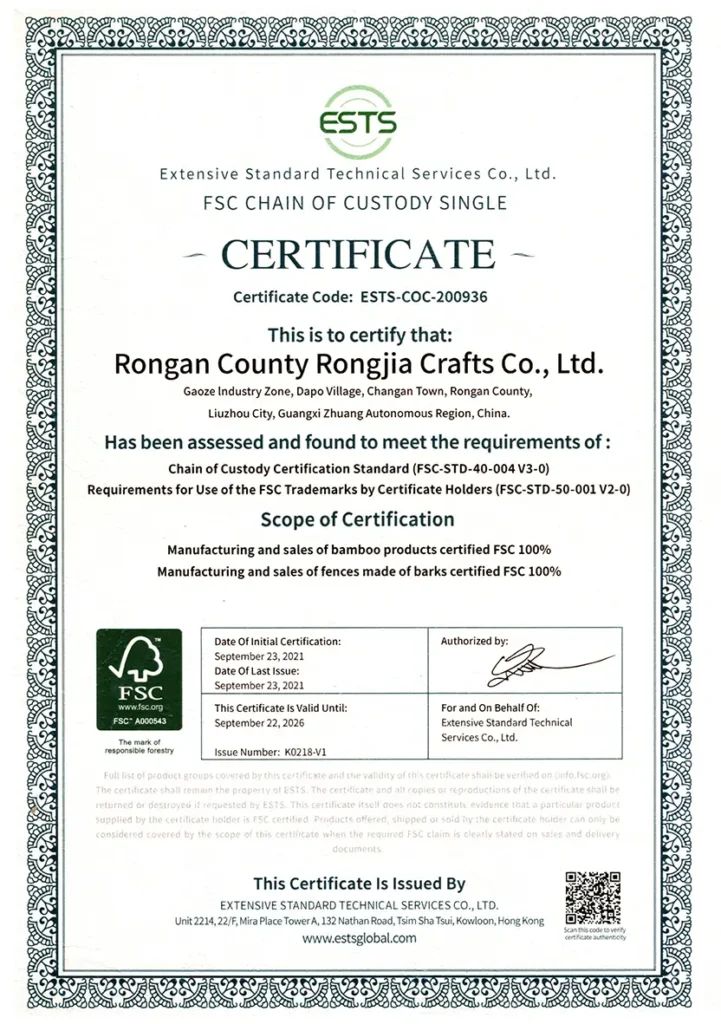
- FSC Certification for Bamboo Products at Rongjia
Bamwoodcraft specializes in the manufacturing of bamboo products for global brands and buyers.
- Sourcing bamboo from FSC certified suppliers
- Maintaining FSC Chain of Custody compliance
- Clear documentation for FSC claim
- Support for OEM and private‑label bamboo products
We help buyers navigate FSC requirements with transparency and professionalism.
- FAQ
Yes.
Although FSC originally focused on timber, bamboo is fully covered under the FSC system. FSC-certified bamboo must follow the same principles of responsible forest management, traceability, and chain-of-custody control as wood products.
Both are required for FSC-labeled products.
FSC-certified forests
FSC Chain of Custody (CoC) certification
Without a valid CoC certificate, a factory cannot legally sell products as FSC-certified, even if the bamboo itself comes from FSC forests.
For FSC 100% or FSC Mix products, factories must implement:
Physical or documented separation between FSC and non-FSC materials
Dedicated material identification (labels, codes, batch numbers)
FSC-specific purchase, inventory, and production records
Staff training related to FSC procedures
Paper compliance alone is not sufficient—auditors will check on-site practices.
Yes, but only under strict control.
Factories may use the same machines if:
Materials are processed in separate batches
Clear cleaning or changeover procedures are documented
Production records clearly distinguish FSC vs non-FSC output
Failure to prove this during audits can lead to certificate suspension.
During an FSC audit, issues may result in:
Corrective Action Requests (CARs)
Temporary suspension of FSC claims
In serious cases, certificate withdrawal
This means products already sold cannot be retroactively labeled as FSC.
FSC uses multi-layer verification, including:
Annual third-party audits
Transaction verification via FSC databases
Cross-checking supplier certificates and scope
Random volume and yield consistency checks
While no system is perfect, systematic fraud carries high risk and long-term consequences, including blacklisting.
No.
FSC certification is not transferable.
Each company in the supply chain that wants to:
Claim FSC status
Use FSC trademarks
Sell FSC-labeled products
must hold its own valid FSC CoC certificate.
Not necessarily.
FSC 100% → Highest material purity, highest cost
FSC Mix → Controlled blending under FSC rules
FSC Mix is widely accepted by:
International retailers
Furniture brands
Large-scale projects
As long as labeling is accurate, FSC Mix is fully compliant.
No.
FSC certification focuses on material sourcing and traceability, not:
Durability
Finishing quality
Performance standards
Quality control must be managed separately through production and inspection systems.