



for Bamboo Panels
Not all bamboo is equal. The age of the culm, the section you harvest, and the conditions of the grove determine whether your finished board is built to last a decade — or fails in two years. This is how we do it at Rongjia, sourcing from Guangxi's finest Moso stands.
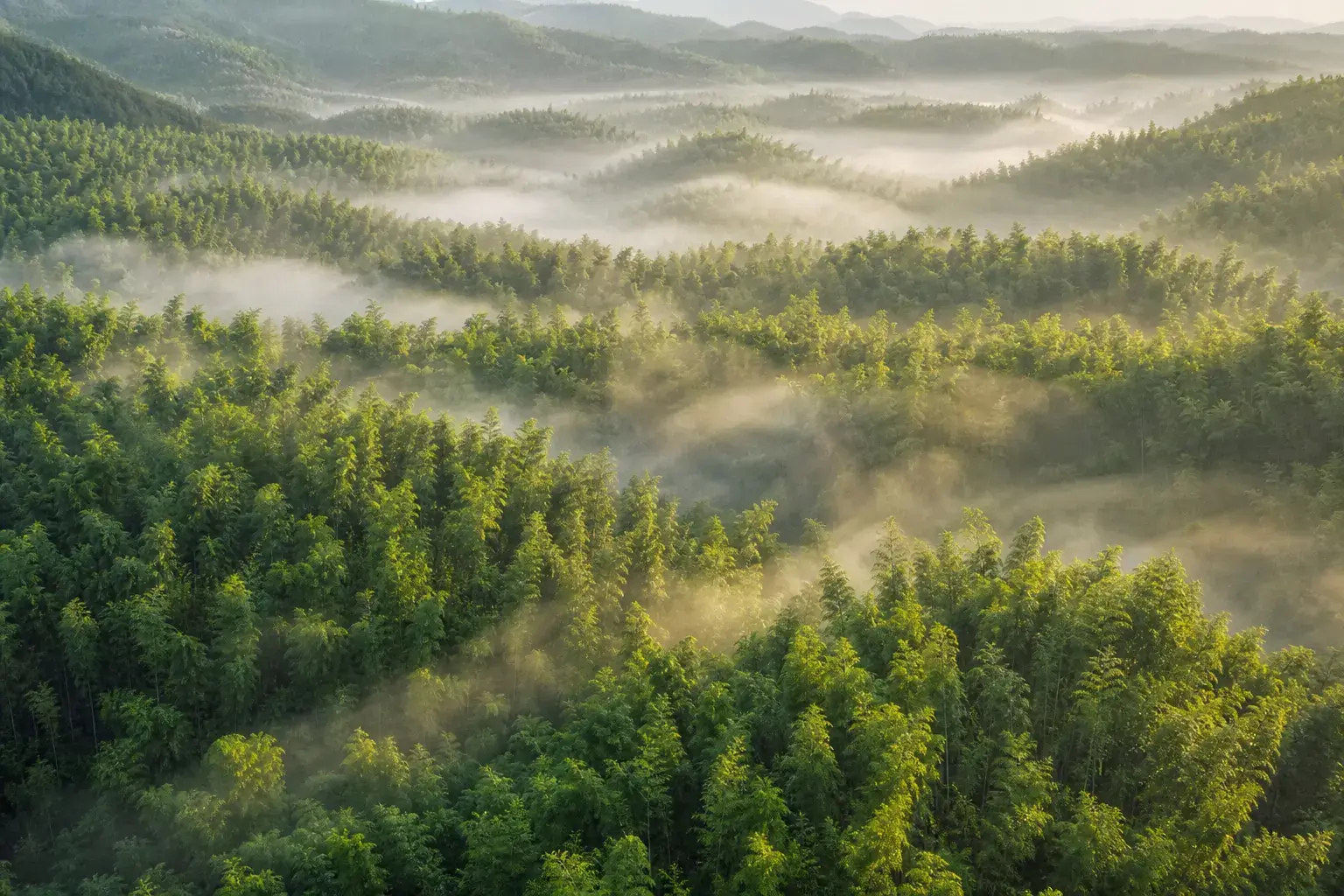
We get asked this a lot: does the bamboo really make that much of a difference in bamboo panels? Honestly, yes — more than most people expect. Two bamboo panels can look identical on a spec sheet and perform completely differently in the field, and nine times out of ten it comes down to what happened before any processing started. The age of the culm. Which section was cut. How it was dried. These decisions happen in Guangxi, not in the factory, and they're the reason we still make the trip ourselves every season.
Guangxi Moso (Phyllostachys edulis) has been our primary raw material for over twenty years. It's not sentimentality — the province just grows better bamboo for panel production than most alternatives. The combination of subtropical humidity, longer frost-free seasons, and mineral-rich red laterite soils produces culms with denser fibre bundles and thicker walls than comparable material from higher-elevation regions. That density is what you're ultimately buying when you choose a bamboo panel: hardness, stability, and resistance to the things that make panels fail early.
Age of Harvest: Why 4–6 Years Is the Sweet Spot
This is the part that surprises most people. Bamboo shoots up to full height in about 60 days — that's not an exaggeration — but the culm doesn't stop developing after that. The height is fixed, but what's happening inside the wall continues changing for years. Fibre density builds up. Moisture drops. Sugars get metabolised. The difference between a two-year culm and a five-year culm shows up directly in the finished bamboo panel — strength, stability, surface hardness.
Phase One — Too Young (1–3 years)
Fresh bamboo is basically still full of water — moisture content above 70% is normal. The fibres haven't lignified yet, which means the material is soft, unpredictable, and prone to splitting the moment you try to process it. Even if you get it through the mill, it'll keep shrinking as it dries and the panel won't hold its shape. We don't touch culms under three years old.
Phase Two — Just Right (4–6 years)
This is the window. By year four, the fibre bundles have hardened off properly, moisture is down to a manageable level, and — this matters more than people realise — the natural sugars that attract beetles and fungi have largely broken down. Compressive and bending strength are both at their peak. If you want bamboo panels that stay flat, machine cleanly, and don't fail in the first few years, this is the age you want.
"The rule we follow is simple: keep all bamboo under 5 years, selectively harvest at 6–7 years, and remove anything over 7. A bamboo grove managed this way stays productive for decades."
Phase Three — Past Its Best (7+ years)
After year seven the culm starts ageing from the inside out. The surface can still look fine — this is where it gets tricky — but the internal fibres have started breaking down. Any bamboo panel made from over-aged culms ends up brittle, prone to delamination, and likely to develop surface cracks within a year or two of installation. We pull anything over seven years during the grove assessment and it never enters our production line.
Where to Cut: The Usable Section of a Culm
Even when the age is right, you still need to know which part of the culm to use. A mature Guangxi Moso pole can run 10 to 15 metres tall, and the material properties change significantly from base to tip. Getting this wrong is one of the more common ways that cheaper bamboo panels are made — using sections that are easier to process but shouldn't be going into finished product.
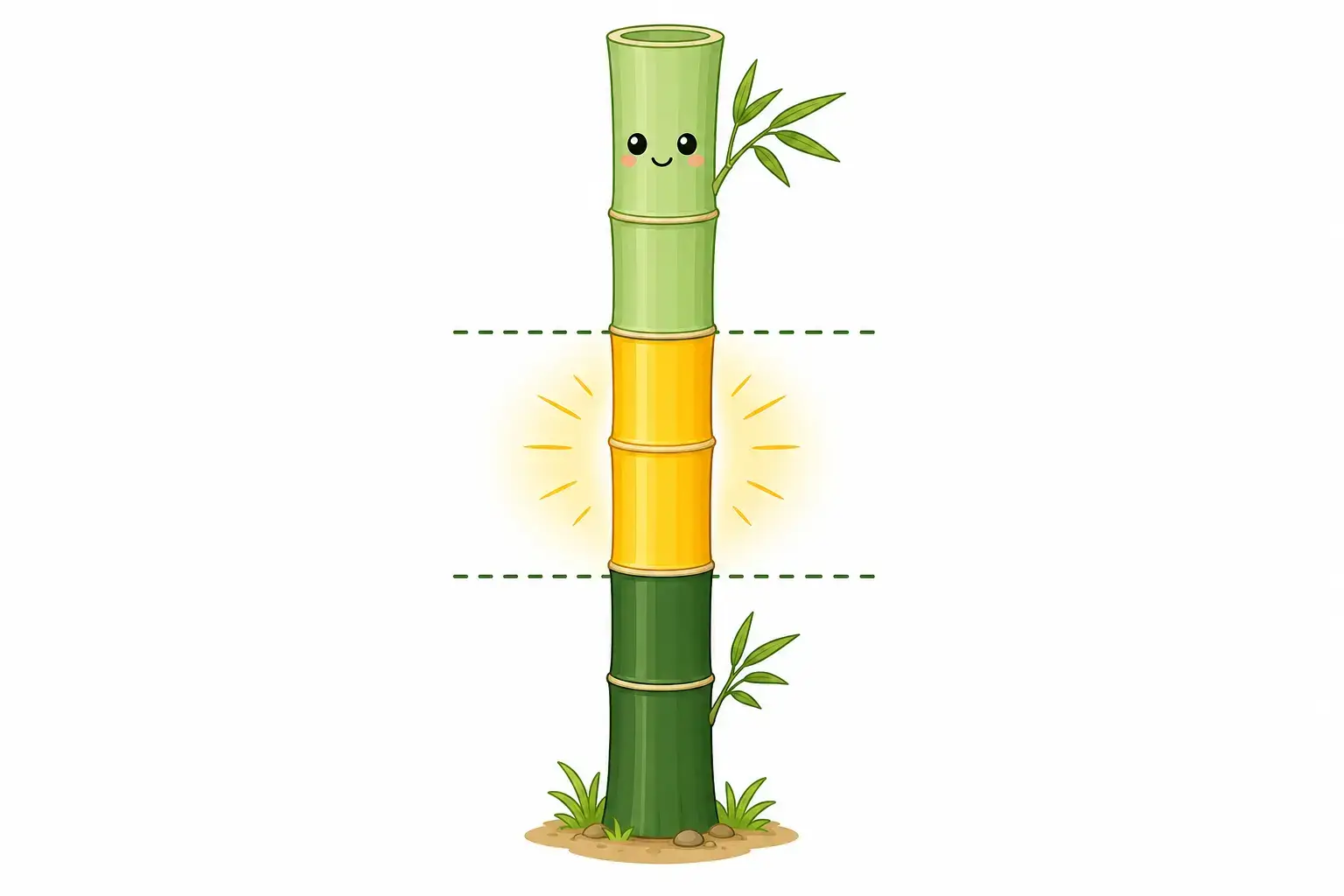
| Section | Height Range | Wall Thickness | Fibre Density | For Board Use |
|---|---|---|---|---|
| Base Section | 0 – 2 m | Very thick | High but uneven | ⚠ Limited — too thick, harder to process evenly |
| Middle Section | 2 – 6 m | Optimal | Highest & most uniform | ✔ Primary harvest zone — best for board materials |
| Upper Section | 6 m+ | Thin | Lower, more variable | ⚠ Secondary use only — weaving, mats, packaging |
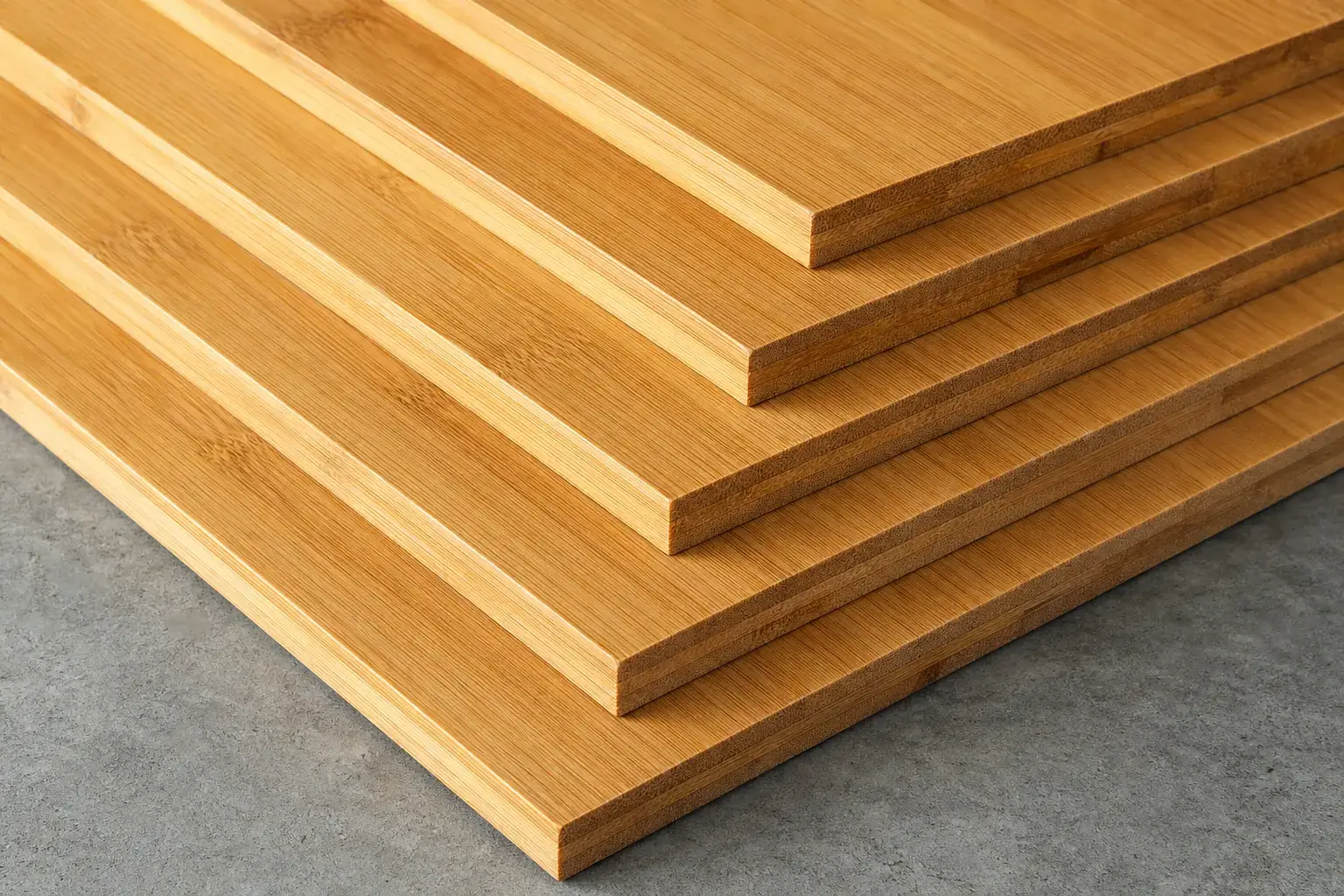
The middle section — from around 2 metres up to about 6 metres — is where you get the best of everything. Wall thickness is consistent, fibre bundles are tightly packed, and the material flattens predictably when you split it. Slats come out even, the surface planes cleanly, and once it's dried it stays put. That's the section that becomes our bamboo panels. The base is too dense and irregular to process efficiently; the upper section is too thin and variable to be reliable. We use the middle, full stop.
Guangxi Advantage
One thing worth knowing: Guangxi Moso regularly gives us middle-section wall thickness of 10–14 mm. That's noticeably more than what you'd typically get from Zhejiang or Fujian material at the same age — the longer growing season and better soils accelerate lignification in a way that shows up in every batch. More usable wall means more yield per culm, and denser fibre means a harder finished surface.
Visual Selection: What Our Graders Look For
Numbers only tell you so much. The people who actually do the selecting in our Guangxi yard have been handling Moso bamboo for years, and there's a lot of knowledge in that experience that doesn't reduce to a spec sheet. Here's what they're actually checking — and why each point matters for the bamboo panels we produce.
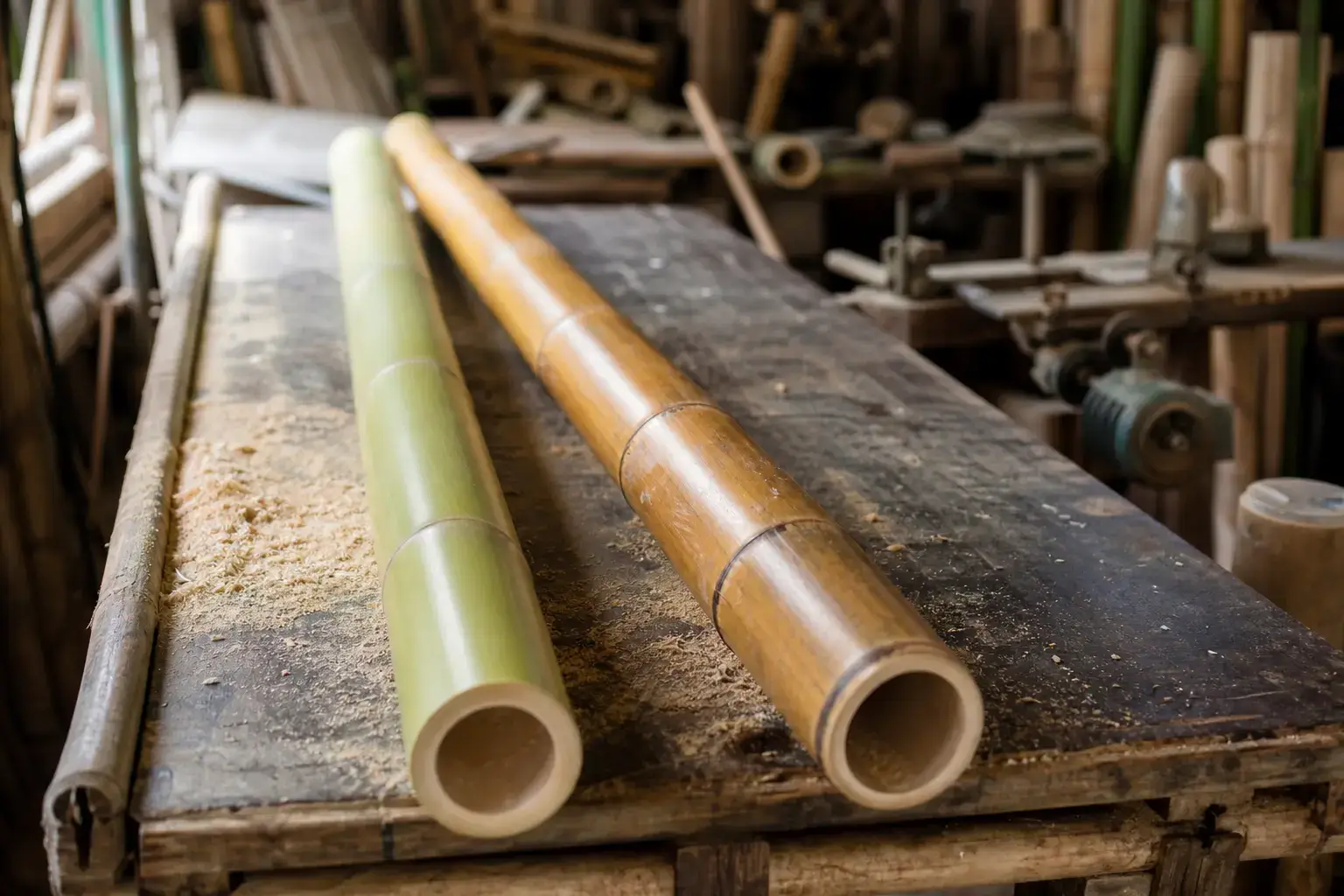
A good 4–6 year culm has a consistent olive-gold or yellow-green colour. Grey patches usually mean it's over-age or there's surface mould starting. Vivid bright green means it's too young. Both get rejected on the spot.
In the middle section, nodes should sit 20–35 cm apart, fairly evenly. Bunched-up irregular nodes are a sign the culm grew under stress. Unusually wide gaps usually mean fast growth in poor soil. Either way, weaker fibre.
Hold it up and look down the length. Any visible bow over 1% of total length means uneven slat thickness after splitting and more waste in milling. Curved culms don't make it through.
Tap along the culm and listen. A clear, solid ring means the wall is sound. Anything dull or hollow-sounding points to internal cracking or early rot. That culm comes out of the pile immediately.
Cracks, splits, beetle holes — any of those and it's rejected. Scuff marks from handling are fine. But if there's a bug entry point anywhere on the culm, it gets quarantined. We don't take chances with that.
We're looking for 80–120 mm outer diameter. Under 80 mm and the slats come out too narrow to assemble efficiently. Over 120 mm and you need extra splitting passes that add time and cost without adding quality.
Moisture Content & Pre-Processing
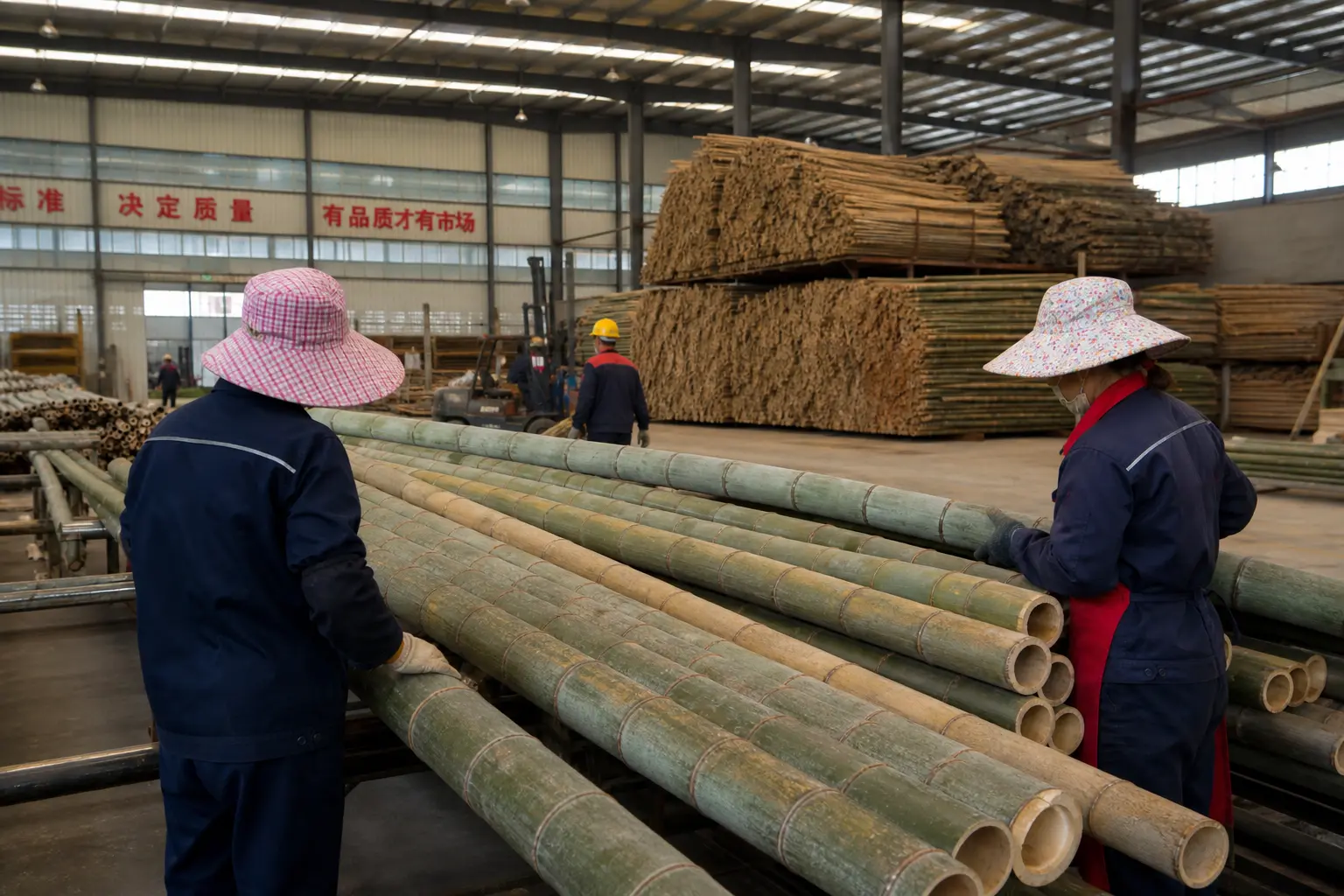
Fresh-cut Guangxi Moso comes in at 60–80% moisture by weight. For bamboo panels, you need to get that down to 8–12% before pressing — that's the range where the bamboo is stable enough to glue properly and the finished bamboo panel won't keep moving after assembly. Sounds straightforward. In practice, rushing this stage is responsible for a lot of the bamboo panel failures we've seen from other suppliers.
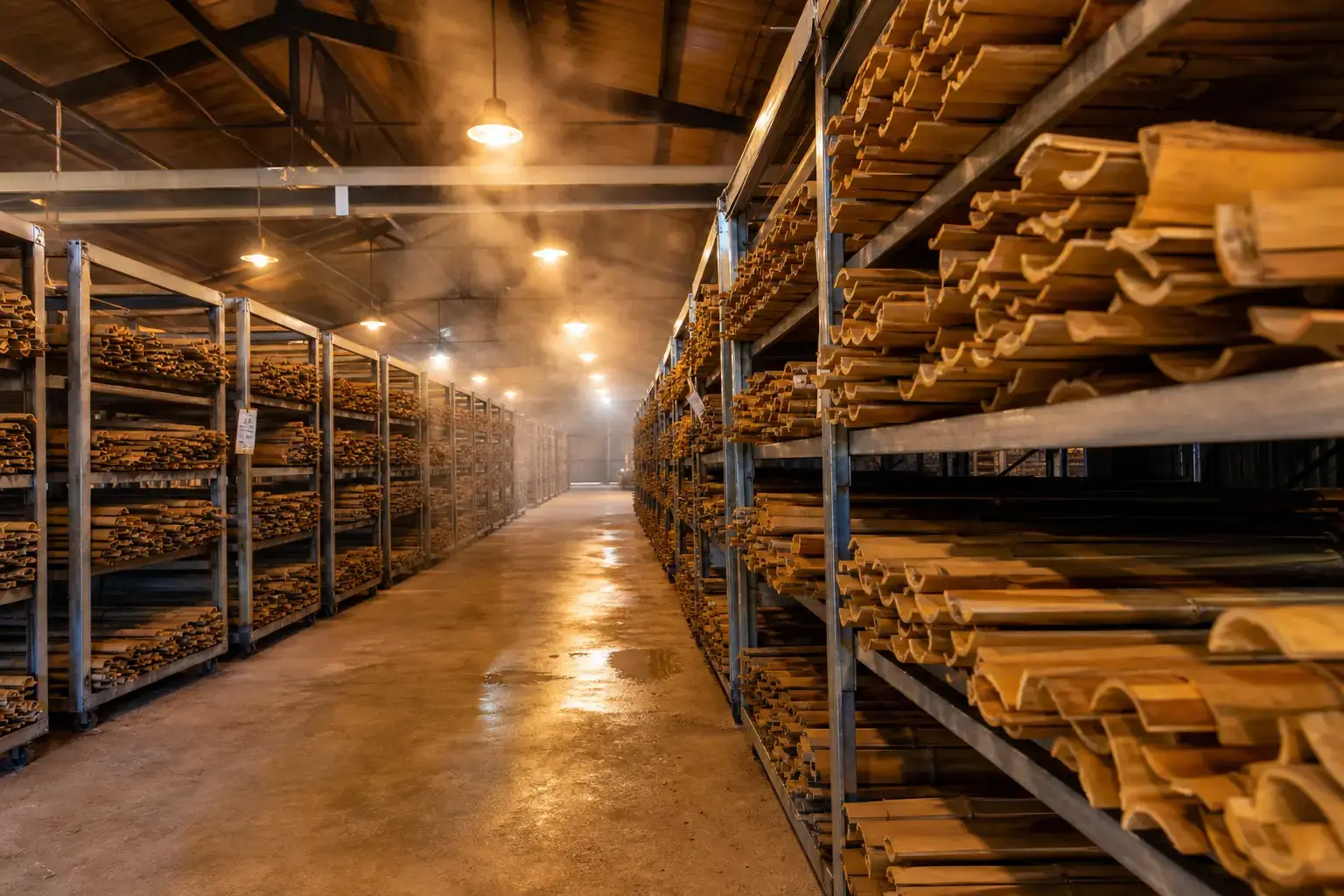
Our process: culms go into covered air-drying in our Guangxi yard for at least 30 days after harvest. No shortcuts there — letting the free water escape slowly is what prevents the surface cracking that happens when bamboo dries too fast. After that, the split slats go into the kiln. We check moisture at multiple points throughout, and nothing moves to the next stage until readings are consistently in range. It adds time. It's worth it.
⚠ What Goes Wrong When Moisture Is Off
Too wet going in — above 14% — and the bamboo panel keeps shrinking after it leaves the press. You get gaps between slats, surface waviness, glue joint failure. Too dry — below 6% — and the bamboo gets brittle. Nodes crack under load. Both are completely avoidable problems that show up because someone skipped a proper drying schedule.
Why Guangxi Moso Sets the Standard
China grows Moso bamboo across eleven provinces. We've sourced from several of them over the years and kept coming back to Guangxi — not out of habit, but because the material consistently outperforms on the things that actually matter for panel production. Harder surface, better yield from the middle section, more predictable drying behaviour.
The growing conditions explain most of it. Southern Guangxi's longer frost-free season means the lignification cycle runs further before the plant goes dormant. The red laterite soils are mineral-rich in a way that shows up in fibre density. The result is a culm that, at the same age as comparable material from higher-elevation provinces, is measurably denser and harder — especially in the outer layer that becomes the wear surface of a finished panel.
We've worked directly with the same grove operators in Guangxi for over twenty years. No middlemen, no spot purchasing. Every culm that comes into our facility is traceable to a specific grove and harvest date. That traceability is what lets us stand behind the quality claims we make — and it's why we're not about to change how we source. Take a look at our bamboo panels, or get in touch if you have a specific project in mind.